PRODUCT STRATEGY · UX/UI · BRAND SYSTEM · HEALTH EDUCATION
Decoding
Plantar Fasciitis
Turning a client’s self-help book and complex vision into a scalable education, research, and digital-product ecosystem.
The client had the expertise and the idea. I created the structure that could bring them to life.
Role
Product Strategist · UX/UI Designer · Brand Designer
Scope
Book/content audit, framework development, information architecture, brand system, responsive product design
Project
Client concept transformed into a scalable digital ecosystem
The Situation
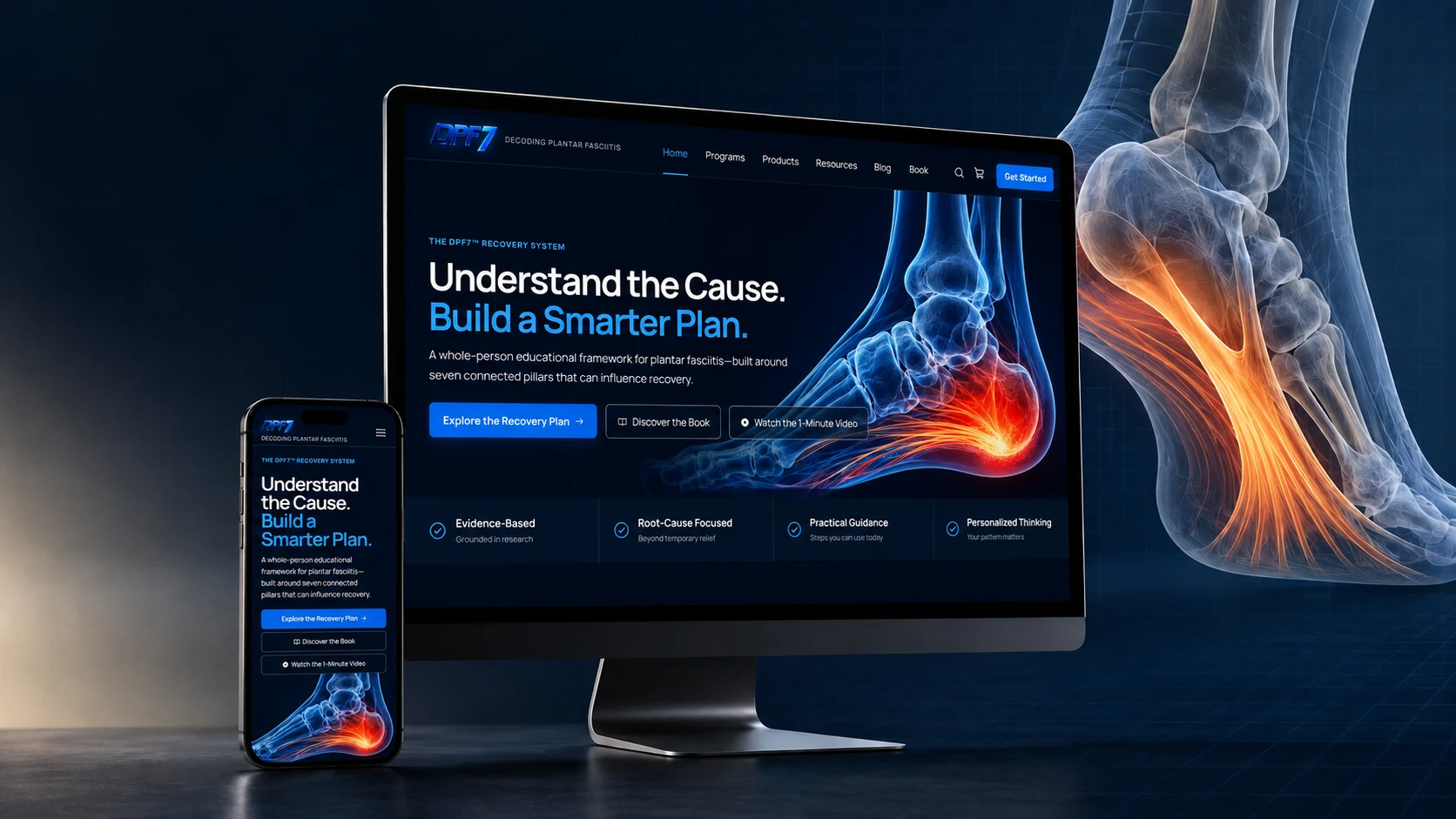
The client had more than a book. She had the beginning of a business.
She wanted to sell the book, offer a free digital product, collect voluntary survey responses for continued research, and lay the foundation for a future educational program. Every piece was valuable on its own, but the ideas lacked one unifying structure.
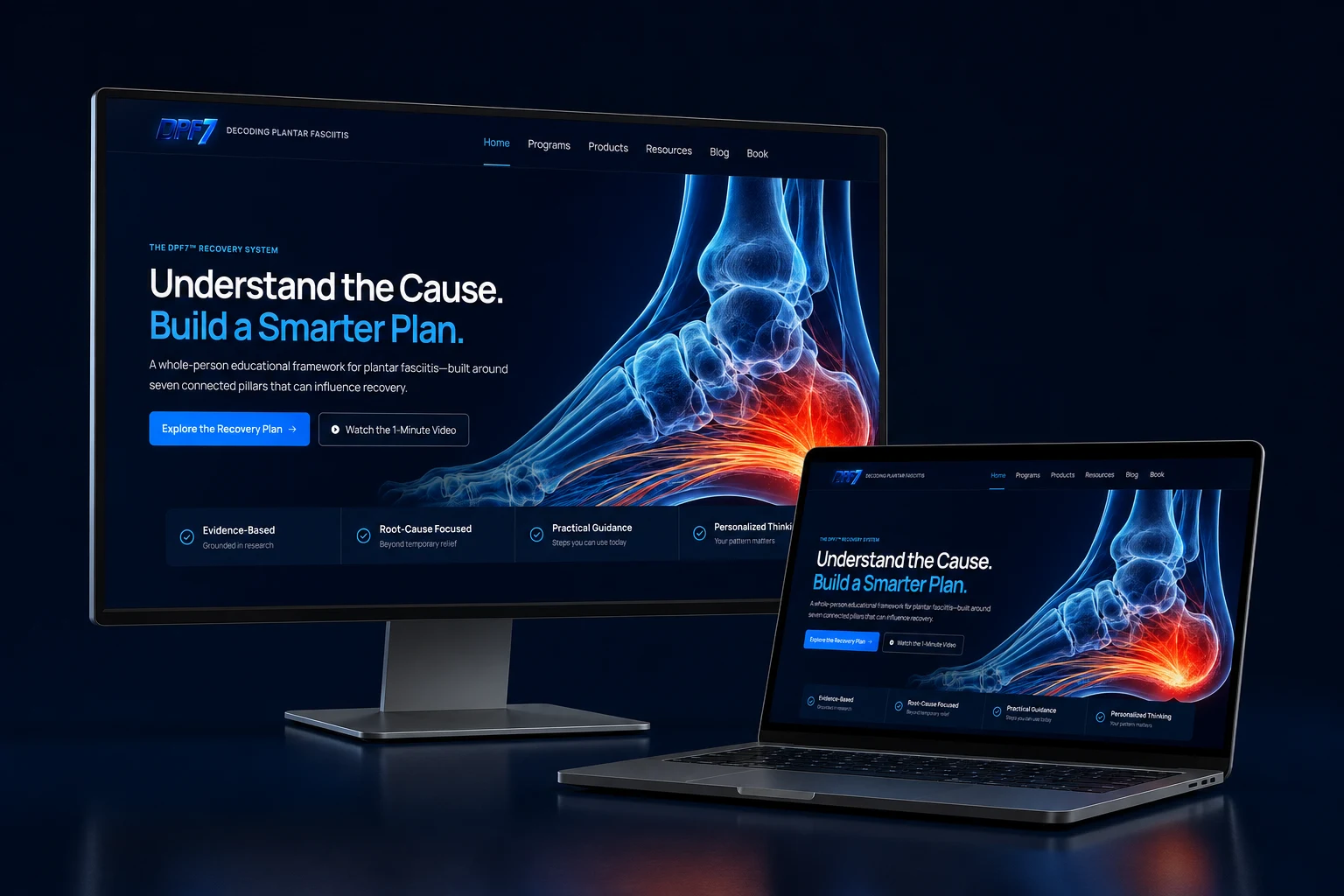
The DPF7 homepage, where the client's book, education, free resource, and research pathway come together as one digital ecosystem.
Pain
Heel or arch discomfort interrupts daily life
Searching
Forums, blogs, and conflicting advice
Isolated tip
One stretch, one product, one trick
Temporary relief
Symptoms ease, but cause remains
Recurrence
Pain returns; confusion deepens
Pain
Heel or arch discomfort interrupts daily life
Searching
Forums, blogs, and conflicting advice
Isolated tip
One stretch, one product, one trick
Temporary relief
Symptoms ease, but cause remains
Recurrence
Pain returns; confusion deepens
The challenge was not simply designing a website. It was deciding how the book, research ambition, free resource, and future program could become one coherent experience.
Product Roadmap
I turned a broad vision into a product roadmap.
The client had no existing design system, digital architecture, or behavioral data. Phase one was about structuring her expert content and building a credible foundation. Everything else could follow from that.
Manuscript analysis
Read the client’s book closely to extract its core ideas and recurring themes.
Seven-pillar framework
Defined seven connected pillars that organize the content into one mental model.
Information architecture & journeys
Mapped the site structure and learning journeys across the ecosystem.
Brand system
Created a visual and verbal identity the client can apply consistently.
Responsive website
Designed the product to work cleanly on desktop, tablet, and mobile.
Connected ecosystem
Linked the book, free product, survey, and future program into one flow.
The Design Challenge
How might we transform a dense self-help book and an ambitious research vision into a trustworthy digital ecosystem that helps people learn, grows the client’s audience, and creates a foundation for future research?
This was not merely a book-sales landing page. It needed to educate, build trust, support conversion, collect data, and scale, all without making unsupported medical claims.
Content Audit & Synthesis
What I read, reviewed, and synthesized
Before designing anything, I immersed myself in the client’s manuscript and the subject. This content audit was not a phase. It was the foundation of every decision that followed.
Primary Source
Close reading of the manuscript
A structured analysis of the client’s self-help book to surface its core ideas, structure, and recurring themes.
Subject-Matter Review
Biomechanics & fascia review
Tissue mechanics, the Superficial Back Line, and trigger-point concepts that explain how symptoms interconnect.
Subject-Matter Review
Nutrition & inflammation review
Dietary factors, systemic inflammation, and tissue-health behaviors that shape recovery timelines.
Subject-Matter Review
Footwear & load management
Daily stressors, gait patterns, standing habits, and how load distribution affects tissue recovery.
Content Review
Educational content review
Review of available plantar-fasciitis guides and articles to find structural gaps and missed connections.
Competitive Analysis
Competitor content review
An audit of how existing resources organize information and where they leave readers stranded.
What I noticed
The manuscript contained valuable information, but it lacked a reusable organizing model. As I read, the same seven themes kept appearing as distinct but connected topics. They became the seven pillars of the framework.
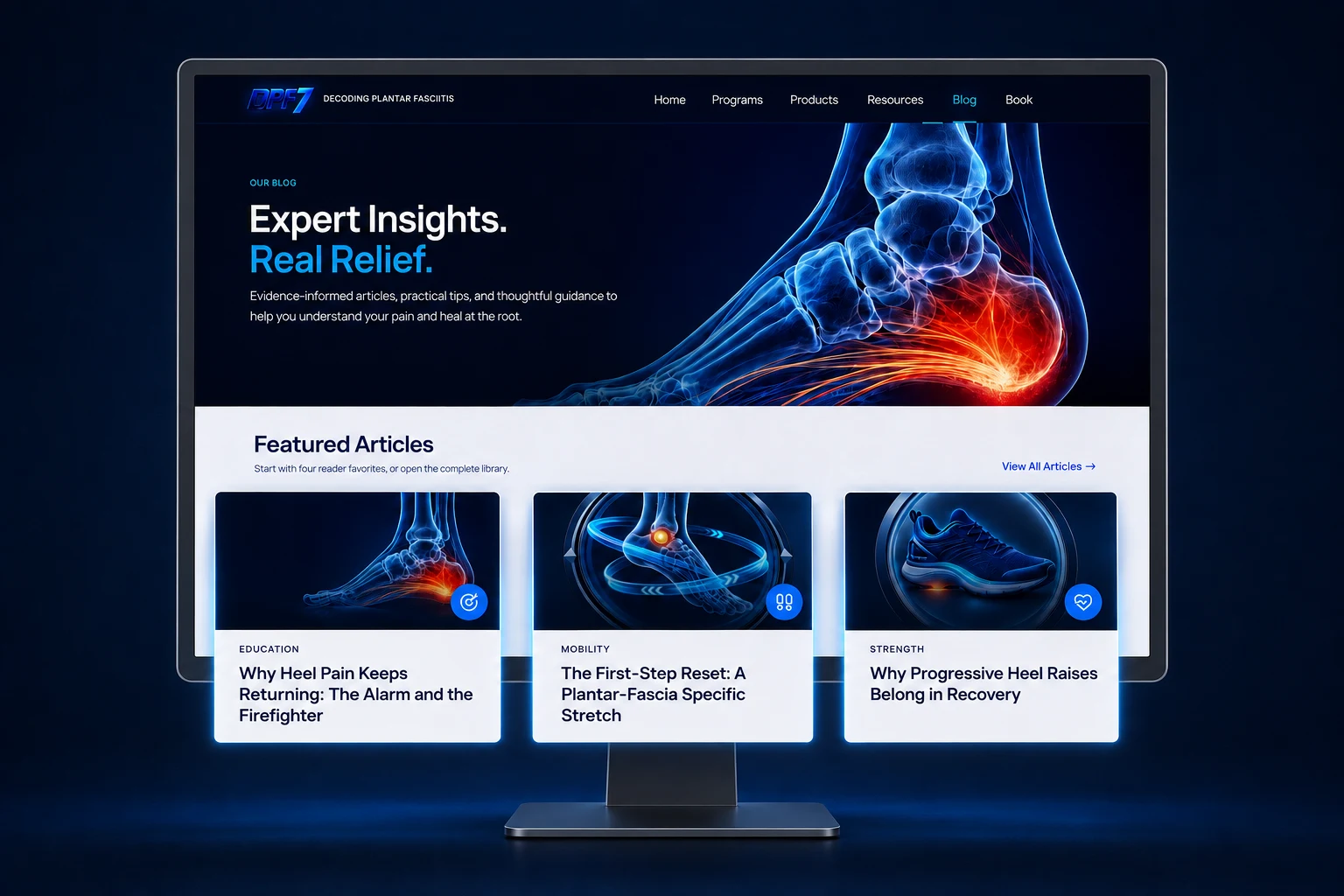
The DPF7 content hub, designed to deliver evidence-based articles and practical guidance.
Pivotal Insight
The breakthrough was not reorganizing pages. It was a reusable framework.
I created a content and product framework the client could use again and again, not just a new arrangement of her existing material.
Chaos
Countless tips, products, and opinions with no organizing principle. Users try everything and connect nothing.
Patterns
Seven recurring themes emerged from the manuscript. Each theme is independent, but they influence one another in real bodies.
System
The DPF7 framework names the seven pillars and shows their relationships. Users finally have a map instead of a pile of directions.
Chaos
Countless tips, products, and opinions with no organizing principle. Users try everything and connect nothing.
Patterns
Seven recurring themes emerged from the manuscript. Each theme is independent, but they influence one another in real bodies.
System
The DPF7 framework names the seven pillars and shows their relationships. Users finally have a map instead of a pile of directions.
The Framework
Seven Interconnected Pillars
The seven pillars are more than a way to organize the book. They give the client an educational structure, a consistent way to organize the site and free product, a brandable methodology, and a foundation for surveys, programs, and future personalized pathways.
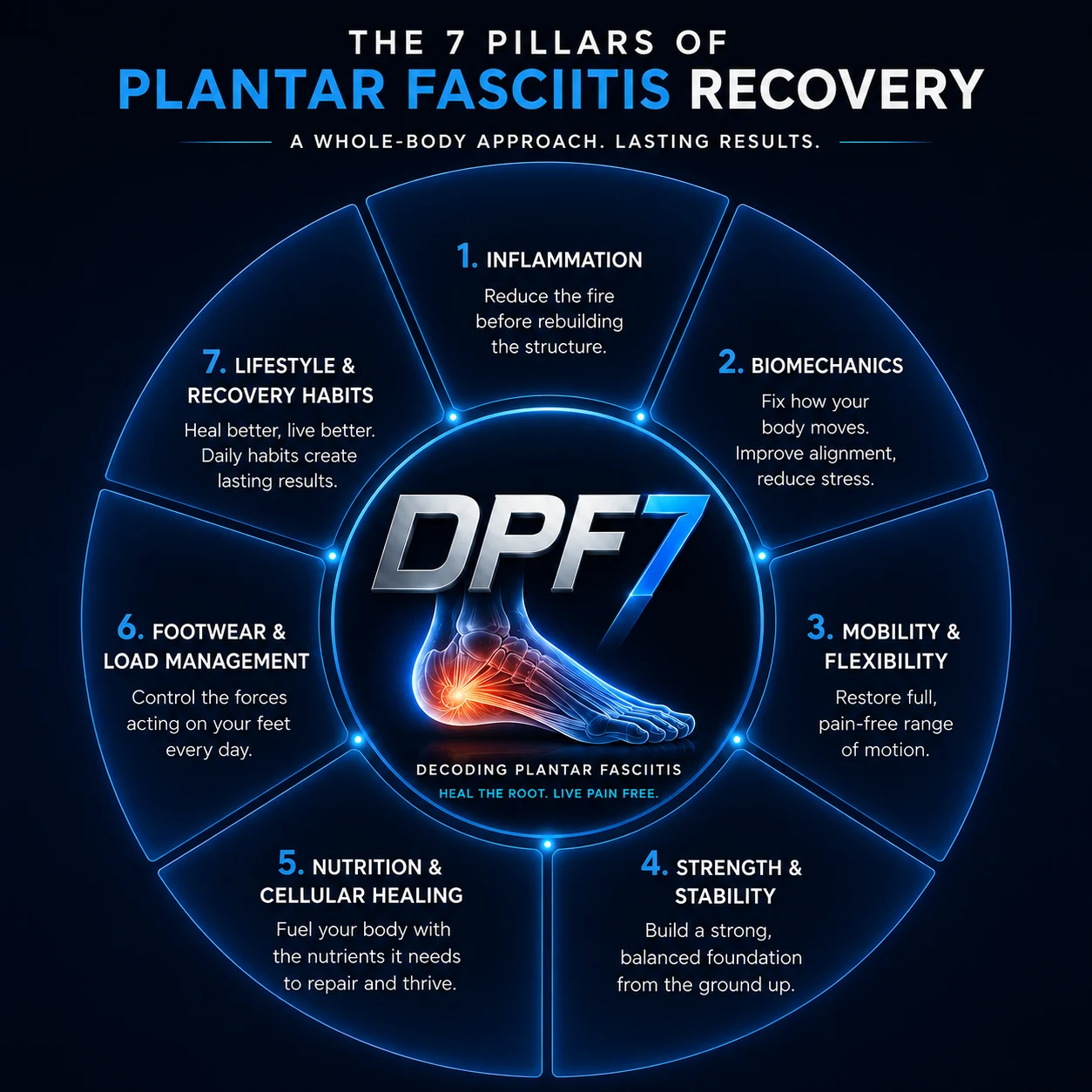
Disclaimer: DPF7 is an educational decision-support framework, not a medical diagnosis or treatment protocol. It is designed to help people understand contributing factors and make informed decisions about what to explore next, in conversation with qualified health professionals.
Evidence to Decision to Design
Every design decision traces back to an observed problem.
I did not start with a visual style. I started with four problems that kept appearing in the manuscript and content review, and designed solutions for each.
Design Decision
Problem
The manuscript presents dense, interconnected material with no single organizing thread.
Design Response
Build a seven-pillar mental model that shows how contributing factors relate to each other rather than competing as separate topics.
Design Decision
Problem
Readers arrive with different knowledge levels, from first-time searchers to informed readers.
Design Response
Use progressive disclosure and a plain-language hierarchy: overview first, depth on demand, so every reader finds their level.
Design Decision
Problem
Health content carries trust risk; one overreaching claim can undermine the entire resource.
Design Response
Keep every statement educational, evidence-conscious, and non-prescriptive: confident but never a medical promise.
Design Decision
Problem
The client had multiple goals: sell the book, offer a free product, collect survey responses, and seed a future program.
Design Response
Design one ecosystem with a clear entry point for each goal, so they reinforce rather than compete.
Health-content trust is earned sentence by sentence
I learned that credibility in this space is cumulative and fragile. One unsupported claim can undo pages of careful work. Every statement in the DPF7 ecosystem is framed as educational context, not medical promise. References are woven into the narrative rather than bolted on at the end.
From Insight to Experience
The framework became a product system.
Research patterns shaped the framework; the framework shaped the architecture, interface and content ecosystem.
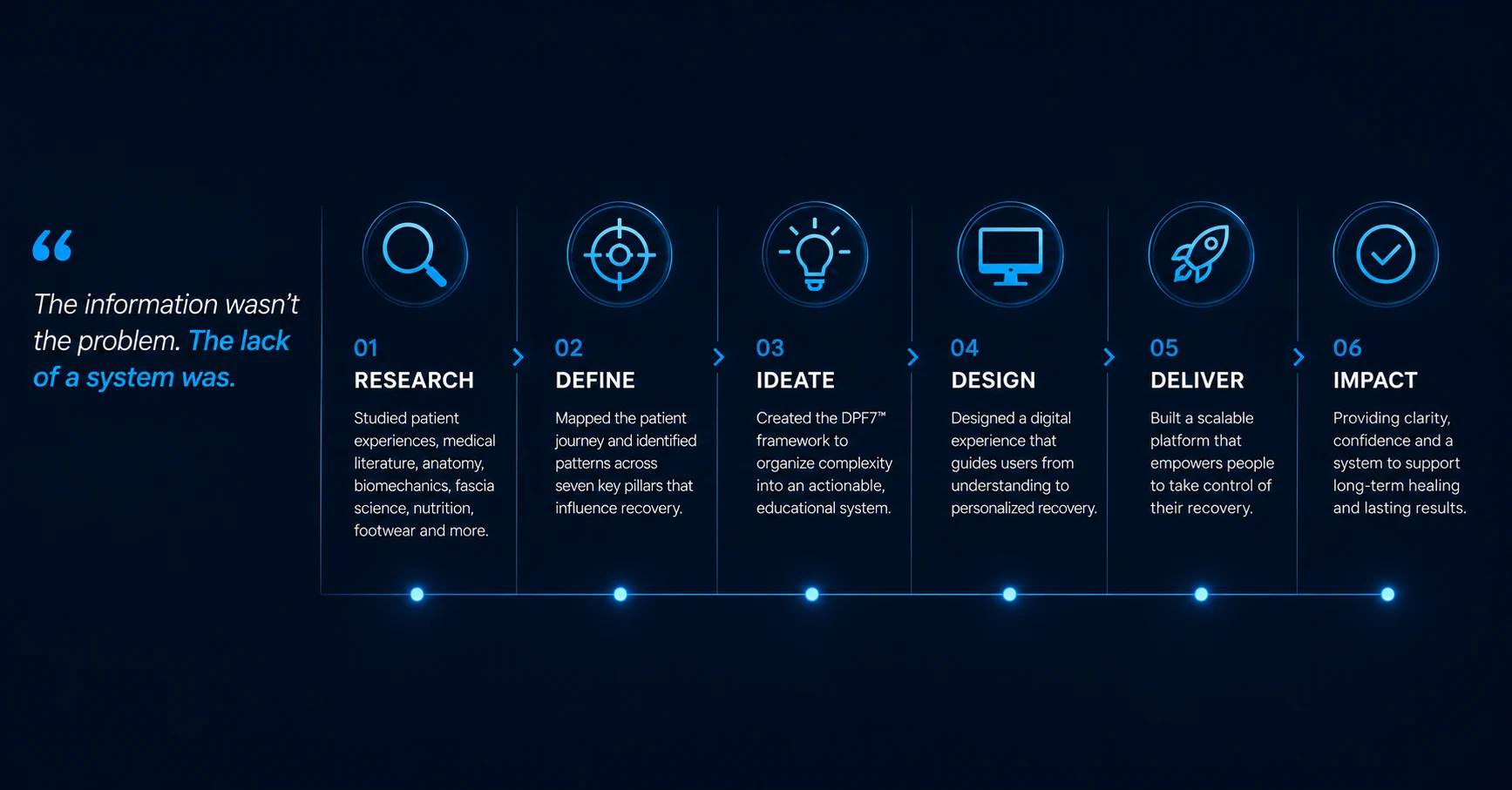
Conceptual process visualization created during design exploration. Impact statements represent intended outcomes, not measured results.
Product Architecture
From question to pathway.
One shared organizing system, DPF7, with distinct entry points for each of the client’s goals. Each piece serves a different job while reinforcing the others.
Book
Paid depth & authority
The client’s self-help book is the authoritative source of the seven pillars.
Website
Central education & navigation hub
The primary entry point that connects learning, the book, the free product, and research.
Free digital product
Low-friction value & audience building
An easy entry point that delivers immediate value and grows the audience.
Survey
PlannedVoluntary planned research channel
A planned channel for continued research. No responses are claimed or measured yet.
DPF7
Shared organizing system
The framework that keeps every format consistent in structure and language.
Program & personalization
PlannedPlanned evolution
The intended future direction, not yet built or validated.
Questions
What is happening and why?
Framework
ActiveThe DPF7 mental model
Content
Evidence-based explanations
Guided Discovery(Conceptual)
Conceptual assessment
Pathway
Personalized exploration
Resources
Book, tools, references
Questions
What is happening and why?
FrameworkActive
The DPF7 mental model
Content
Evidence-based explanations
Guided Discovery(Conceptual)
Conceptual assessment
Pathway
Personalized exploration
Resources
Book, tools, references
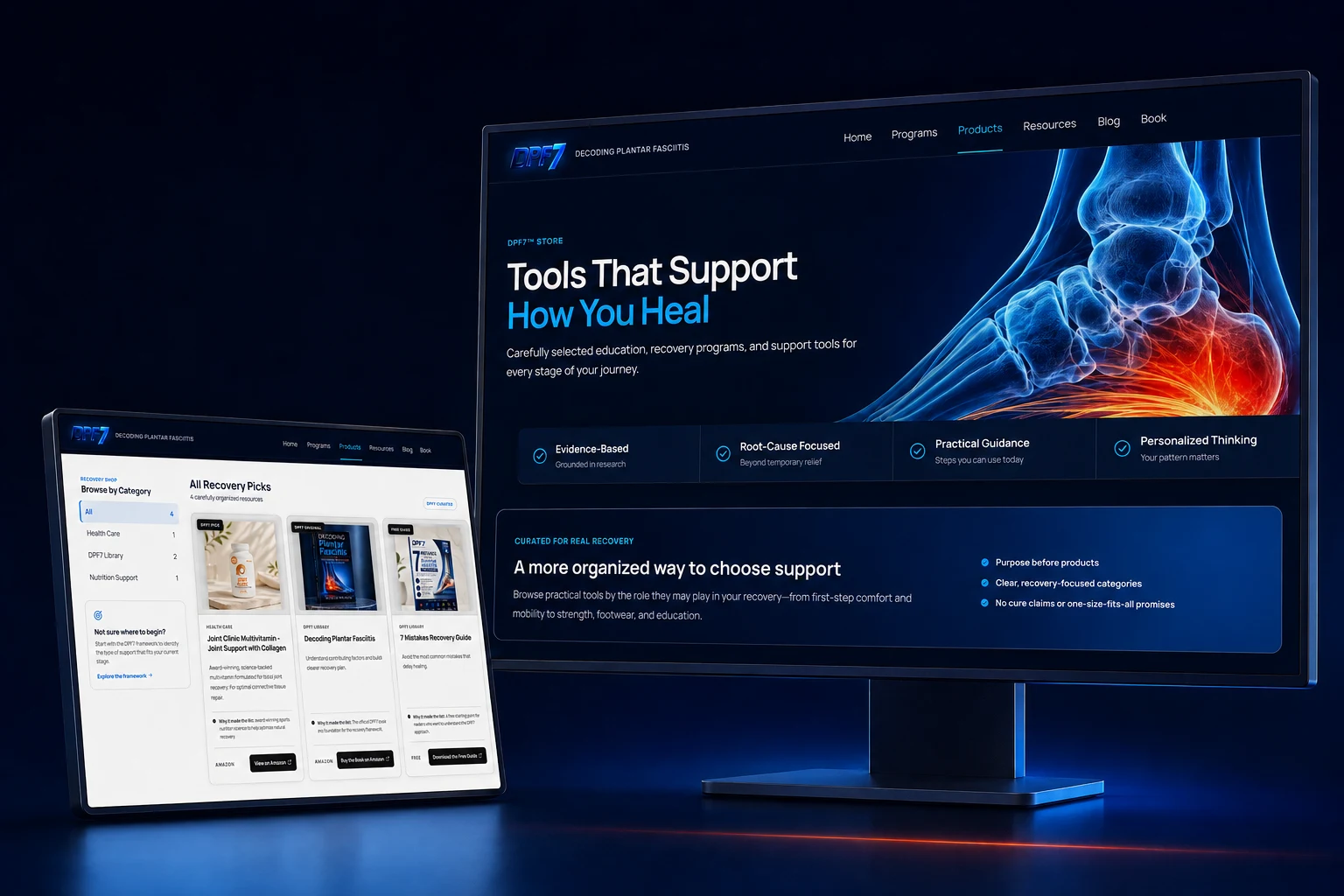
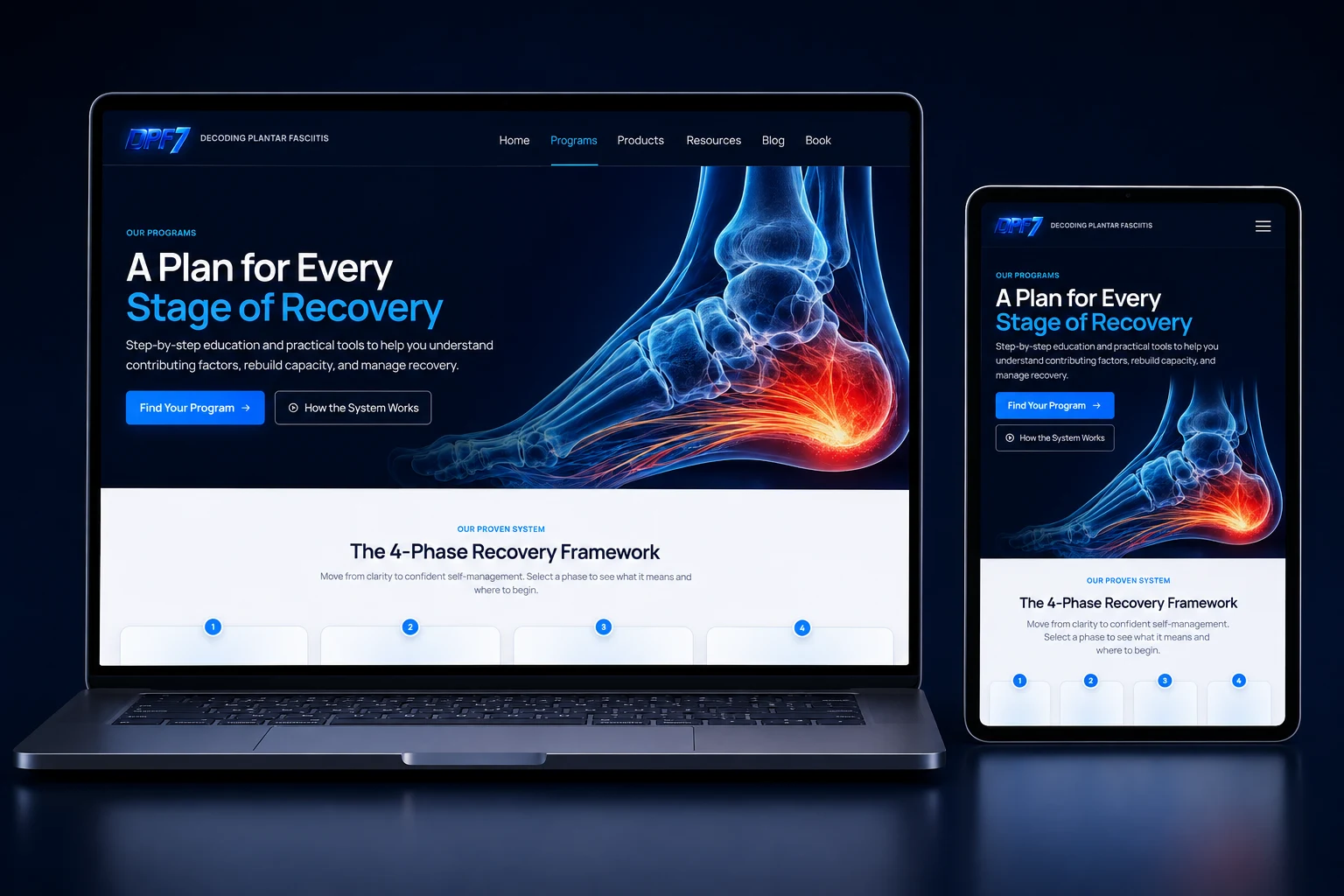
The Products and Programs pages, offering curated recovery tools and step-by-step education across desktop and mobile.
About assessment and personalization
The guided discovery and personalized pathway steps represent the intended future evolution of the platform. The current system provides the content architecture, visual system, and content foundation required to support these features. They are labeled as conceptual to be transparent about what is built today versus what the system is designed to grow into.
How the Experience Evolved
Structure first, then surface.
I moved from manuscript to framework to brand to responsive experience. The brand balances medical credibility, accessibility, and hope, and because it is a system rather than a single page, it can extend beyond one book to every future format.
The DPF7 website interface, designed for scan-ability, progressive depth, and cross-device readability.
Information Architecture
I organized the manuscript’s content around the seven pillars rather than page count. This serves the audience, who always know where they are, and the business, where every piece of content has a clear path to the book, free product, and survey.
Visual Hierarchy
The brand balances medical credibility, accessibility, and hope. High-contrast type, generous whitespace, and plain-language headings make dense content approachable without diluting its authority.
Responsive Reflow
The layout adapts without breaking the content sequence, so the experience stays coherent across desktop, tablet, and mobile. This supports both audience needs and the client’s goal of reaching readers wherever they are.
Information Architecture
I organized the manuscript’s content around the seven pillars rather than page count. This serves the audience, who always know where they are, and the business, where every piece of content has a clear path to the book, free product, and survey.
Visual Hierarchy
The brand balances medical credibility, accessibility, and hope. High-contrast type, generous whitespace, and plain-language headings make dense content approachable without diluting its authority.
Responsive Reflow
The layout adapts without breaking the content sequence, so the experience stays coherent across desktop, tablet, and mobile. This supports both audience needs and the client’s goal of reaching readers wherever they are.
Final Experience
Three connected experiences, one coherent system.
Three connected experiences built on one organizing method. Users can start anywhere: learn, buy the book, get the free resource, or join the research, and never feel lost.
Educational Website
The hub that connects learning, the book, the free resource, and research participation across every device.
DPF7 Framework
The organizing method I developed from the client’s content: seven pillars that interconnect into one complete picture.
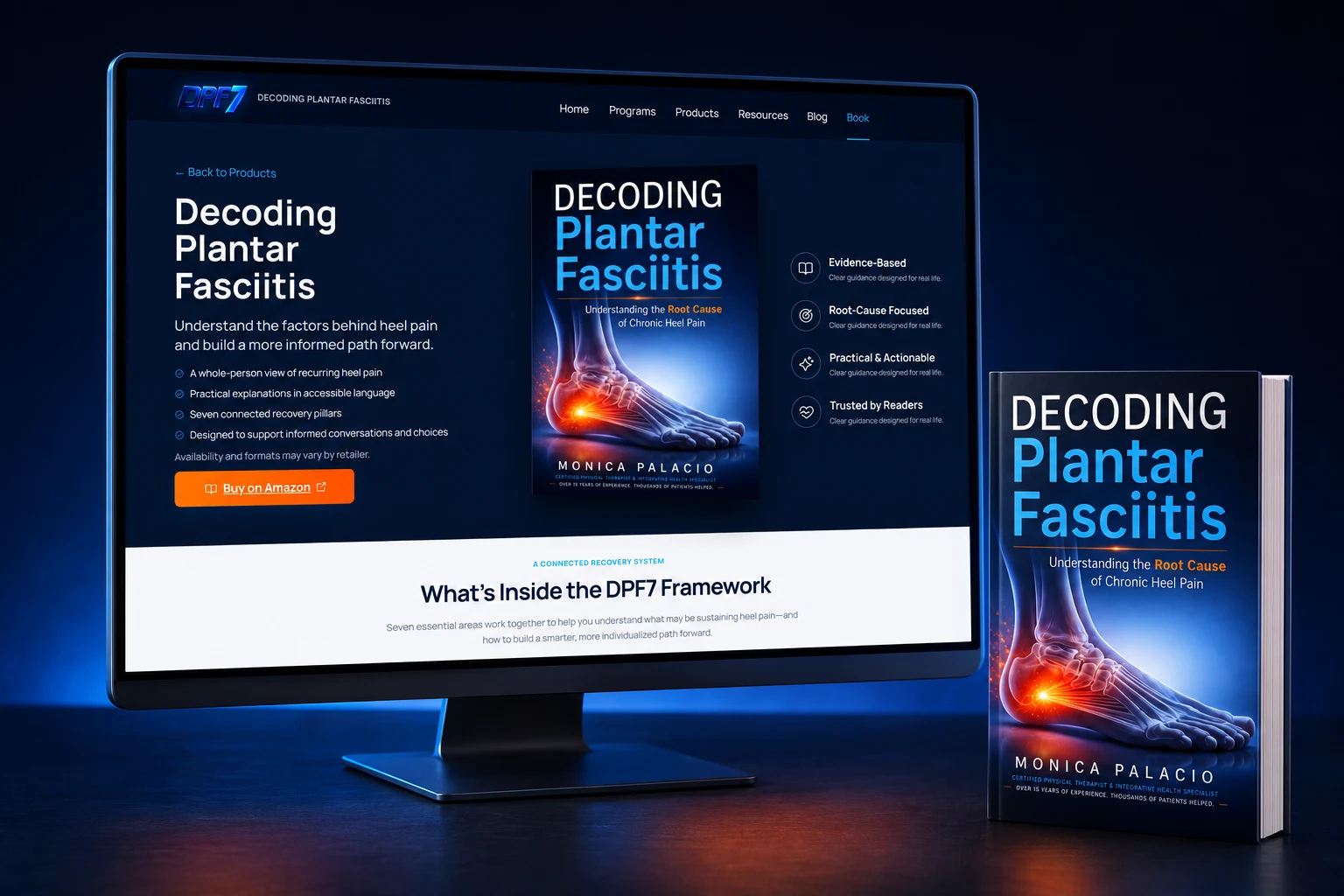
Book & Digital Content Ecosystem
The client’s expertise extended into reusable digital experiences, with the same structure and language.
Each format serves a different context, but they all share the same information architecture. That consistency is what makes the system trustworthy.
UGC Videos
In her own words, and in readers’ hands.
Short-form clips that put the book and the ecosystem in front of real readers. The collection opens with the client’s book introduction, followed by reader-facing content from the same platform.
Client · Book Introduction
Decoding Plantar Fasciitis — Book Introduction
The client introduces the book and the idea behind it: understanding plantar fasciitis as connected factors rather than one isolated symptom.
UGC · Reader Perspective
Reader story: from scattered tips to a clear path
A reader-facing clip showing how the education and ecosystem come together, walking through the pillars and the resources built around them.
UGC · Community Submission
UGC clip: living with plantar fasciitis
A short-form community clip capturing the day-to-day reality behind the content, and why clear, connected guidance matters.
UGC · Community Submission
UGC clip: a reader’s recovery journey
Another short-form community clip showing how readers connect the seven pillars to their own recovery and daily routines.
Clips are shown as produced. No performance metrics or audience results are claimed.
Validation & Outcomes
Honest outcomes, and what should come next.
These are delivered design and strategic outcomes, not measured user or business results. No survey data, analytics, interviews, or usability testing has been run yet.
Design Outcome
Coherent seven-pillar information system
Scattered recovery topics now connect through one shared mental model that scales across formats.
Design Outcome
Scalable DPF7 brand & visual system
A unified design language the client can apply consistently across the website and future media.
Design Outcome
Connected book, website & free-resource experience
The book, website, and free resource share the same structure, language, and visual hierarchy so readers never feel lost.
Design Outcome
Research-ready survey pathway & program foundation
A clear entry point for the planned survey, plus a content architecture ready to support a future program.
What Should Be Tested Next
Next Test
Pillar comprehension
Can visitors understand the seven-pillar model?
Next Test
Ecosystem navigation
Can they find the book, free resource, and survey without confusion?
Next Test
Survey quality
Does the survey wording produce useful, responsible research data?
Next Test
Free-product trust
Does the free product build trust and support an appropriate next step?
Proposed Success Measures
When this work moves into testing, the measures I would track are: navigation success, free-resource completion, survey completion and response quality, email opt-in conversion, book call-to-action engagement, and self-reported comprehension and confidence. Every one of these is proposed; none have been measured yet.
Design System
A focused clinical visual language.
Built for clarity, trust, and action. Every token, component, and rule was designed to support health-content credibility and cross-device readability.
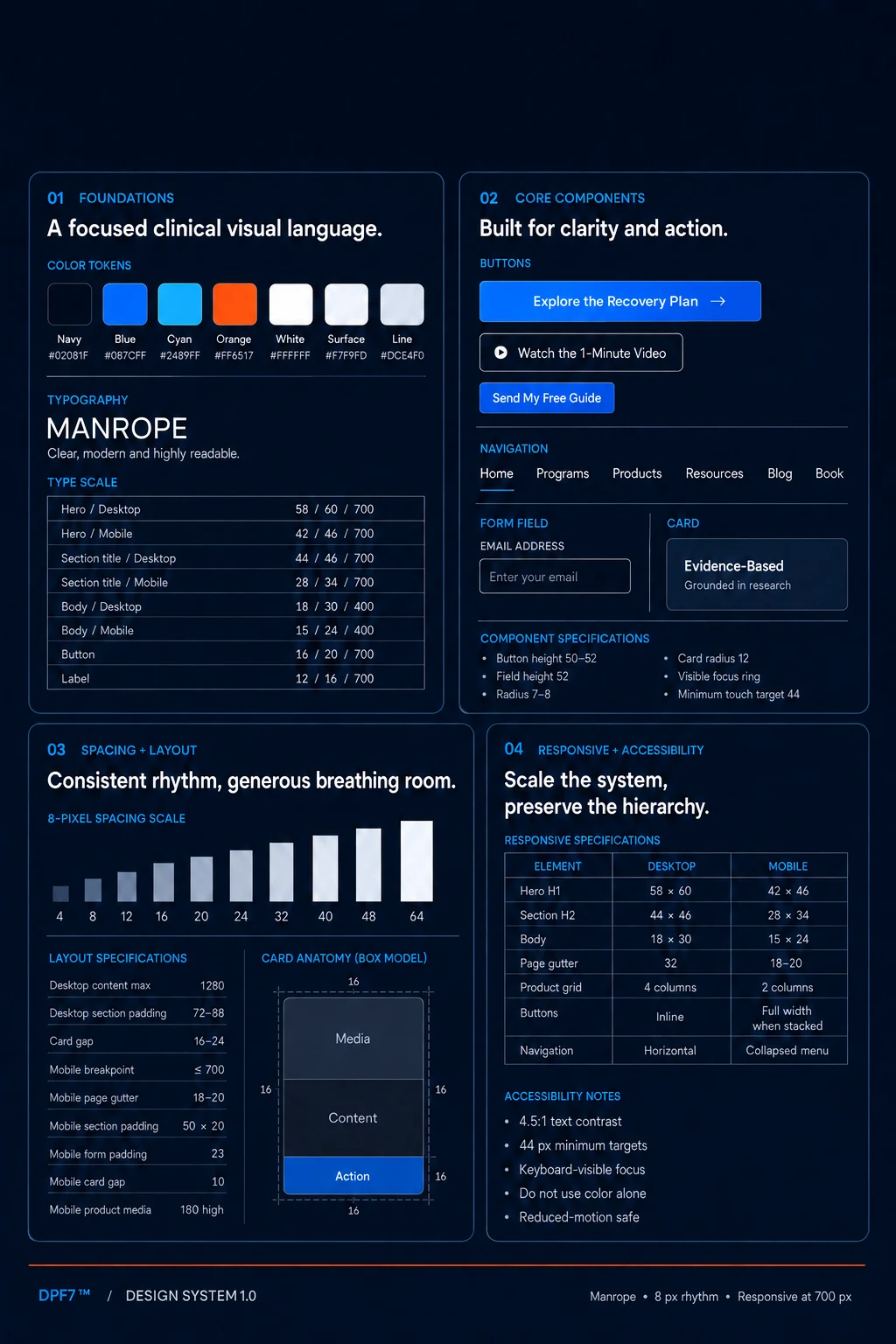
The complete DPF7 design system, from foundations to responsive behavior and accessibility.
01 Foundations
A focused clinical visual language.
Color Tokens
Navy
#02081F
Blue
#0B7CFF
Cyan
#2489FF
Orange
#FF6517
White
#FFFFFF
Surface
#F7F9FD
Line
#DCE4F0
Typography
MANROPE
Clear, modern and highly readable.
Type Scale
02 Core Components
Built for clarity and action.
Buttons
Navigation
Form Field
Email Address
Card
Evidence-Based
Grounded in research
Component Specifications
03 Spacing + Layout
Consistent rhythm, generous breathing room.
8-Pixel Spacing Scale
Layout Specifications
Card Anatomy (Box Model)
04 Responsive + Accessibility
Scale the system, preserve the hierarchy.
Responsive Specifications
Accessibility Notes
Reflection
A complex idea becomes a product when its relationships are made clear.
My strongest contribution was translating the client’s expertise into a framework, a brand, a roadmap, and a coherent digital system. The book already held the knowledge; my work made its structure visible and reusable.
What comes next
Responsible survey testing, accessibility and usability validation, content-comprehension testing, and post-launch measurement.
If this way of thinking is what you need on your team, let's talk.
I bring product strategy, systems thinking, UX/UI, content architecture, and brand-building to complex problems. I would love to talk about how I can contribute to what you are building.